
Ankle Sprain
Outcome: Re-injury
Comparison: Functional (external support and weight-bearing) vs Immobilisation (below knee cast)
Evidence snapshot
Volume
Data from 956 participants (10 RCTs)
Magnitude and Direction of effect
Statistical Fragility
Certainty of evidence
Support the project
If you found this evidence summary useful, you can support the continued development of independent evidence reviews.
Contributions help support ongoing literature surveillance, data synthesis, and site maintenance.
Evidence in detail
Inclusion criteria
- Randomized controlled trials
- Population: Adults with acute lateral ligament injury
- Intervention: Functional treatment (external support with progressive weight-bearing)
- Comparator: Immobilisation (below-knee cast)
- Outcome: Re-injury (at least 6 month follow up)
Outcome definition and data extraction
Re-injury was defined according to the criteria used in each individual trial. Data were extracted at the longest reported follow-up. Analyses were conducted using the number randomised as the denominator, consistent with an intention-to-treat approach.
Effect measure and data pooling
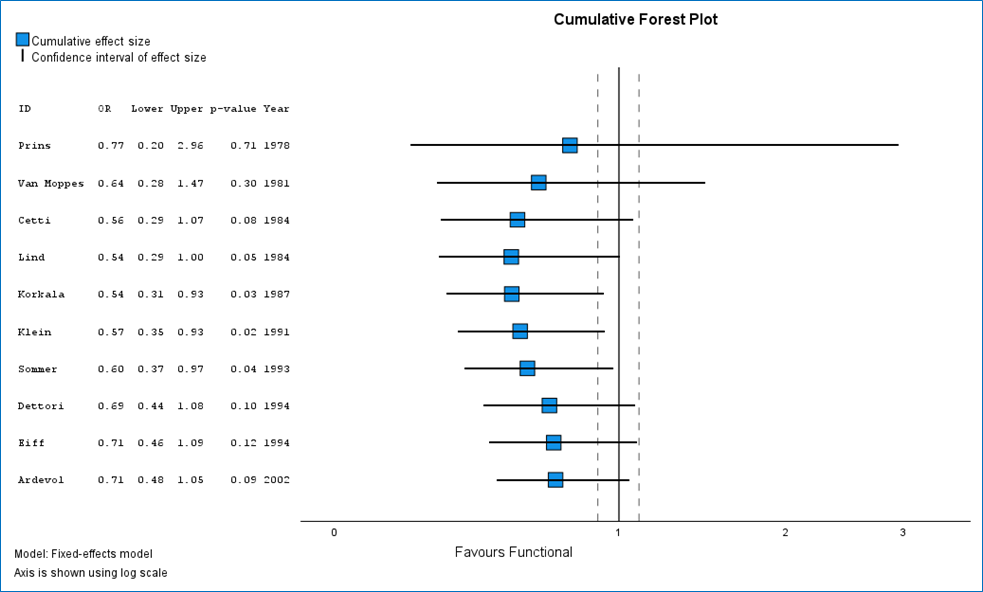
Odds ratios were calculated for each trial and pooled using a fixed-effects model. Statistical heterogeneity was assessed using Cochran’s Q and the I² statistic, which quantifies the proportion of variability attributable to between-study differences rather than sampling error. Observed heterogeneity was negligible (I² = 0%; Q = 4.99, df = 9, p = 0.84), indicating that variability in effect estimates was consistent with sampling error and that there was no evidence of meaningful between-study inconsistency.
Assessment of evidence quality and robustness
Risk of bias was evaluated using the PEDro scale. Statistical robustness was assessed using the Fragility Index, defined as the minimum number of event reversals required to alter statistical significance. Certainty of evidence was evaluated using the GRADE framework.
The analytical framework underpinning this Living Review, including statistical methods, fragility analysis, and certainty assessment, is described in the Methods page.
Results
Included trials
10 RCTs involving 956 participants were included. (Trial characteristics in Appendix 1)
Follow-up ranged from 6 months to 2 years.
Effect estimate
Early mobilisation with external support did not demonstrate a statistically significant reduction in recurrent injury compared with rigid immobilisation (OR 0.71, 95% CI 0.48 to 1.05; pooled data from 10 trials; p = 0.09). Although the point estimate favours early mobilisation, the confidence interval includes the null effect and spans clinically important benefit through to trivial harm, indicating uncertainty regarding the comparative effectiveness of these strategies.
Forest plot
Fragility
Fragility analysis was not performed because the pooled estimate was not statistically significant; the Fragility Index is designed to assess the robustness of significant findings.
Publication bias
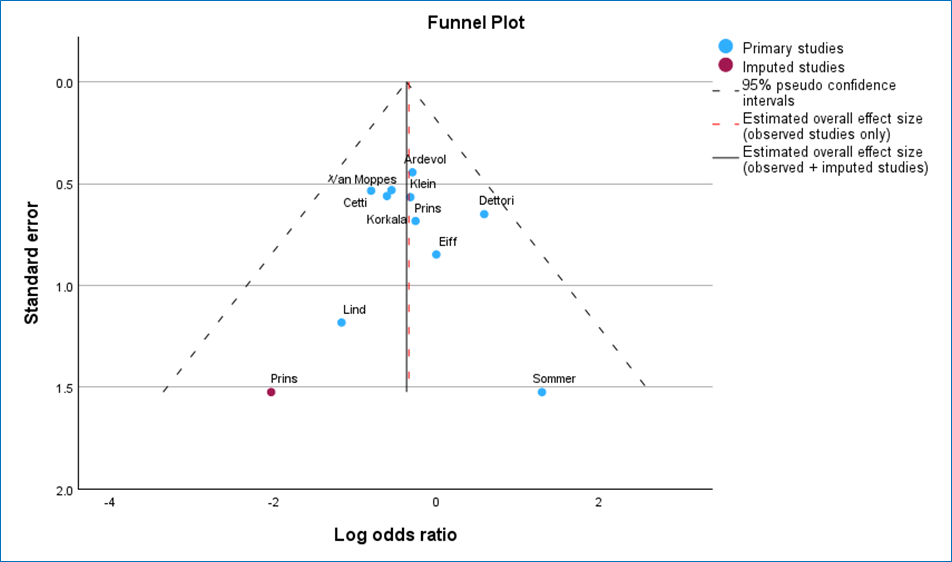
Trim-and-fill analysis suggested one potentially missing study; however, adjustment resulted in only minimal change to the pooled estimate (log OR −0.34 to −0.36) and did not alter statistical significance (p = 0.089 to p = 0.063) (Appendix 2). This indicates that any potential small-study effects are unlikely to materially influence the overall conclusion. Nevertheless, the power of funnel-based methods remains limited when the number of included trials is modest.
Certainty of evidence
Certainty of evidence was rated as very low using the GRADE framework. Evidence was downgraded by two levels for very serious risk of bias, as the body of evidence was dominated by methodologically limited trials (only one study scored >5 on the PEDro scale; Appendix 1), and by one level for imprecision, as the pooled confidence interval included the null effect and spanned clinically important benefit through to trivial harm. Consequently, the true effect may be substantially different from the pooled estimate. Further adequately powered, prospectively registered, and methodologically robust trials are required to reduce uncertainty and inform clinical decision-making.
Interpretation
Although no additional randomised trials comparing rigid immobilisation with early mobilisation using external support have been published since 2002, the absence of new studies should not be interpreted as evidence that the question has been resolved. The existing evidence base is small, methodologically limited, and characterised by imprecision, resulting in very low certainty of evidence.
In such circumstances, the lack of subsequent trials likely reflects a shift in clinical practice rather than stability of the evidence base. Importantly, the available data do not demonstrate a consistent or precise treatment effect, meaning that uncertainty regarding the comparative effectiveness of these strategies remains.
Appendix 1: Characteristics of included studies

Appendix 2: Funnel Plot
References (included studies)
Prins JG. Diagnosis and treatment of injury to the lateral ligament of the ankle. A comparative clinical study. Acta Chir Scand Suppl. 1978;486:3-149.
Korkala O, Rusanen M, Jokipii P, Kytömaa J, Avikainen V. A prospective study of the treatment of severe tears of the lateral ligament of the ankle. Int Orthop. 1987;11(1):13-7. doi: 10.1007/BF00266052.
van Moppes, F. I., & van den Hoogenband, C. R. (1982). Diagnostic and therapeutic aspects of inversion
trauma of the ankle joint. [Doctoral Thesis, Maastricht University]. Rijksuniversiteit Limburg.
Cetti R, Christensen SE, Corfitzen MT. Ruptured fibular ankle ligament: plaster or Pliton brace? Br J Sports Med. 1984 Jun;18(2):104-9. doi: 10.1136/bjsm.18.2.104.
Lind T. Konservativ behandling af laterale ligamentrupturer i fodleddet. Prospektiv sammenligning af to konservative behandlingsmetoder [Conservative treatment of rupture of the lateral ligament of the ankle. Prospective comparison of 2 conservative therapeutic methods]. Ugeskr Laeger. 1984 Dec 17;146(51):4017-9.
Klein J, Rixen D, Albring T, Tiling T. Funktionelle versus Gipsbehandlung bei der frischen Aussenbandruptur des oberen Sprunggelenks. Eine randomisierte klinische Studie [Functional versus plaster cast treatment of acute rupture of the fibular ligament of the upper ankle joint. A randomized clinical study]. Unfallchirurg. 1991 Feb;94(2):99-104.
Sommer HM, Schreiber H. Die früh-funktionelle konservative Therapie der frischen fibularen Kapsel-Band-Ruptur aus sozial-ökonomischer Sicht [Early functional conservative therapy of fresh fibular capsular ligament rupture from the socioeconomic viewpoint]. Sportverletz Sportschaden. 1993 Mar;7(1):40-6. German. doi: 10.1055/s-2007-993482.
Dettori JR, Basmania CJ. Early ankle mobilization, Part II: A one-year follow-up of acute, lateral ankle sprains (a randomized clinical trial). Mil Med. 1994 Jan;159(1):20-4.
Eiff MP, Smith AT, Smith GE. Early mobilization versus immobilization in the treatment of lateral ankle sprains. Am J Sports Med. 1994 Jan-Feb;22(1):83-8. doi: 10.1177/036354659402200115.
Ardèvol J, Bolíbar I, Belda V, Argilaga S. Treatment of complete rupture of the lateral ligaments of the ankle: a randomized clinical trial comparing cast immobilization with functional treatment. Knee Surg Sports Traumatol Arthrosc. 2002 Nov;10(6):371-7. doi: 10.1007/s00167-002-0308-9.
Update Log
- March 2026: Page created on Ankle Evidence Hub
- Next scheduled update: June 2026 (or sooner ! if you know of a RCT in this field that meets our inclusion criteria – get in touch HERE)