
Ankle Sprain
Outcome: Recurrent injury
Comparison: Basic Care vs Basic Care PLUS Exercise based rehabilitation
Evidence snapshot
Volume
Data from 1,753 participants (10 RCTs)
Magnitude and Direction of effect
Statistical Fragility
Certainty of evidence
Support the project
If you found this evidence summary useful, you can support the continued development of independent evidence reviews.
Contributions help support ongoing literature surveillance, data synthesis, and site maintenance.
Evidence in detail
Inclusion criteria
- Randomized controlled trials
- Population: Adults with acute lateral ankle sprain (within 2 weeks of injury; no restrictions placed on injury grade)
- Intervention: Basic care PLUS structured exercise-based rehabilitation (no restrictions placed on exercise content or volume)
- Comparator: Basic care only (usually PRICE and basic exercises)
- Outcome: Recurrent injury (at least 3 month follow up)
Outcome definition and data extraction
Re-injury was defined according to the criteria used in each individual trial. Data were extracted at the longest reported follow-up. Analyses were conducted using the number randomised as the denominator, consistent with an intention-to-treat approach.
Effect measure and data pooling
Odds ratios were calculated for each trial and pooled using a random-effects model. Statistical heterogeneity was assessed using the I² statistic, which quantifies the proportion of variability due to between-study differences rather than sampling error. Statistical heterogeneity was moderate (I² = 61%, H² = 2.58), indicating that a substantial proportion of variability in effect estimates was attributable to true differences between studies rather than sampling error.
Assessment of evidence quality and robustness
Risk of bias was evaluated using the PEDro scale. Statistical robustness was assessed using the Fragility Index, defined as the minimum number of event reversals required to alter statistical significance. Certainty of evidence was evaluated using the GRADE framework.
The analytical framework underpinning this Living Review, including statistical methods, fragility analysis, and certainty assessment, is described in the Methods page.
Results
Included trials
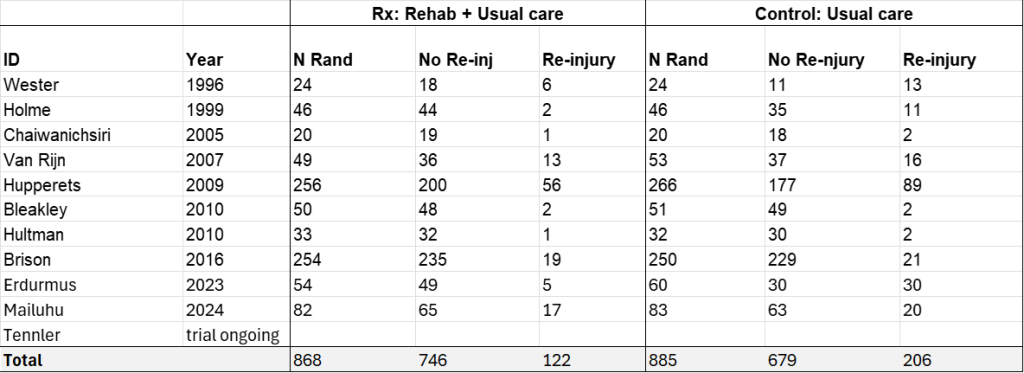
10 RCTs involving 1,753 participants were included. (Trial characteristics in Appendix 1)
Follow-up ranged from 3 to 12 months.
Effect estimate
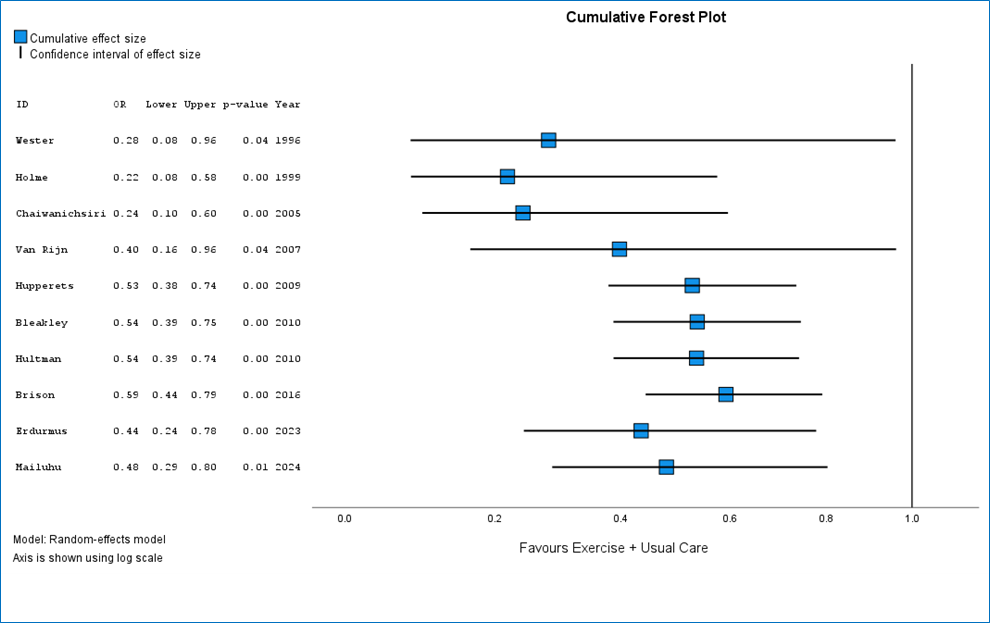
Rehabilitation reduced the risk of recurrent ankle sprain compared with usual care (OR 0.48, 95% CI 0.29 to 0.80; pooled data from 10 trials). This corresponds to an absolute risk reduction of approximately 9.2% and a number needed to treat (NNT) of 11, indicating that one re-injury is prevented for every 11 individuals who complete a rehabilitation programme. Below is a Cumulative Forest Plot summarising available data in this field, ordered by date of publication.
Forest plot
Heterogeneity
Statistical heterogeneity was moderate (I² = 61%), indicating variability in effect sizes across included trials. While the direction of effect was broadly consistent, the magnitude of benefit varied between studies, suggesting that the pooled estimate reflects a distribution of effects rather than a single common effect.
Fragility
The Fragility Index was 47. This means that the statistical significance would be lost if 47 outcome events across the included trials were changed from non-events to events (or vice versa).
For context, a total of 289 of 1,753 participants (16.5%) did not complete follow-up. The Susceptibility Index, calculated as the ratio of the Fragility Index to the number of participants lost to follow-up, was 0.16. This indicates that the number of participants lost to follow-up was substantially greater than the number of event reversals required to alter statistical significance, suggesting that the observed effect may be vulnerable to incomplete outcome data.
Publication bias
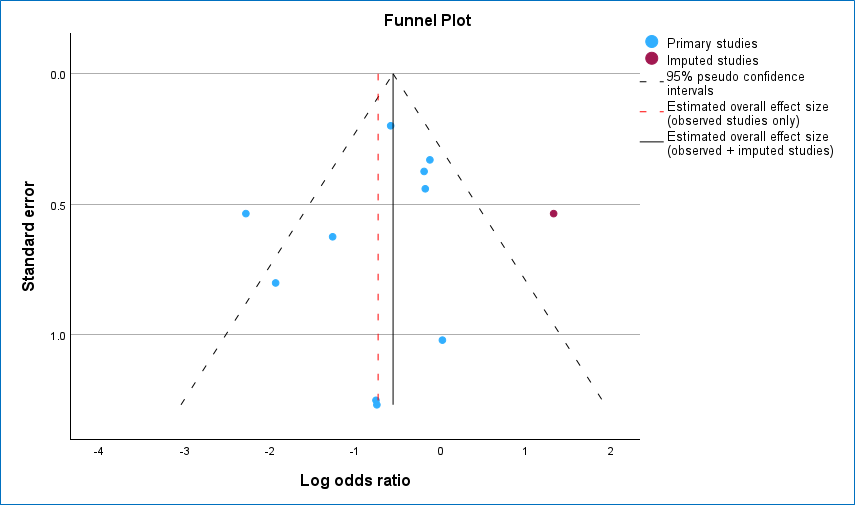
Trim-and-fill analysis imputed one potentially missing study located in the region favouring usual care (Appendix 2). Adjustment for this study attenuated the statistical significance of the pooled effect (Z = −2.79, p = 0.005 to Z = −1.77, p = 0.076), although the direction of effect remained unchanged. This suggests that the overall finding may be sensitive to small-study effects and potential publication bias
Certainty of evidence
Certainty of evidence was rated as moderate using the GRADE framework. Evidence was downgraded due to overall risk of bias, as reflected by PEDro scores below 7 in several trials (Appendix 1). Moderate between-study heterogeneity (I² = 61%) indicates variability in effect sizes across studies, although the direction of effect was broadly consistent. There is also vulnerability to missing outcome data, as reflected by the Susceptibility Index, and adjustment for small-study effects attenuated statistical significance. While these factors introduce uncertainty, they were not considered sufficient to warrant further downgrading. Further high-quality, prospectively registered trials may influence this estimate.
Interpretation
The pooled analysis indicates that adding rehabilitation to usual care after ankle sprain is associated with a reduction in the risk of recurrent injury (OR 0.48, 95% CI 0.29 to 0.80). While the direction of effect was consistent across most trials and corresponds to a clinically meaningful absolute benefit, moderate heterogeneity (I² = 61%) indicates that the magnitude of effect varied across studies. In addition, adjustment for small-study effects attenuated statistical significance, suggesting some uncertainty in the robustness of the estimate.
Importantly, even the upper bound of the confidence interval (OR 0.80), representing the least favourable plausible estimate, remains consistent with a clinically meaningful reduction in re-injury risk.
Overall, the existing evidence supports the use of rehabilitation following ankle sprain, while highlighting uncertainty in the precise size and stability of the treatment effect. Ongoing prospectively registered trials, including Tennler et al. (2023) (ISRCTN13640422), are expected to contribute further data and may meaningfully refine this estimate in future updates.
Appendix 1: Characteristics of included studies
Appendix 2: Funnel Plot
References (included studies)
Bleakley CM, O’Connor SR, Tully MA, Rocke LG, Macauley DC, Bradbury I, Keegan S, McDonough SM. Effect of accelerated rehabilitation on function after ankle sprain: randomised controlled trial. BMJ. 2010 May 10;340:c1964. doi: 10.1136/bmj.c1964.
Brison RJ, Day AG, Pelland L, Pickett W, Johnson AP, Aiken A, Pichora DR, Brouwer B. Effect of early supervised physiotherapy on recovery from acute ankle sprain: randomised controlled trial. BMJ. 2016 Nov 16;355:i5650. doi: 10.1136/bmj.i5650.
Chaiwanichsiri D, Lorprayoon E, Noomanoch L. Star excursion balance training: effects on ankle functional stability after ankle sprain. J Med Assoc Thai. 2005 Sep;88 Suppl 4:S90-4.
Erdurmuş ÖY, Oguz AB, Genc S, Koca A, Eneylı MG, Polat O. Comparison of the effects PRICE and POLICE treatment protocols on ankle function in patients with ankle sprain. Ulus Travma Acil Cerrahi Derg. 2023 Aug;29(8):920-928. doi: 10.14744/tjtes.2023.29797.
Holme E, Magnusson SP, Becher K, Bieler T, Aagaard P, Kjaer M. The effect of supervised rehabilitation on strength, postural sway, position sense and re-injury risk after acute ankle ligament sprain. Scand J Med Sci Sports. 1999 Apr;9(2):104-9. doi: 10.1111/j.1600-0838.1999.tb00217.x.
Hultman, K., Fältström, A., & Öberg, U. (2010). The effect of early physiotherapy after an acute ankle sprain. Advances in Physiotherapy, 12(2), 65–73. https://doi.org/10.3109/14038190903174262
Hupperets MD, Verhagen EA, van Mechelen W. Effect of unsupervised home based proprioceptive training on recurrences of ankle sprain: randomised controlled trial. BMJ. 2009 Jul 9;339:b2684. doi: 10.1136/bmj.b2684.
Mailuhu AK, Verhagen EA, van Ochten J, Bindels PJ, Bierma-Zeinstra SM, van Middelkoop M. E-health intervention for preventing recurrent ankle sprains: a randomised controlled trial in general practice. Br J Gen Pract. 2023 Dec 28;74(738):e56-e62. doi: 10.3399/BJGP.2022.0465.
van Rijn RM, van Os AG, Kleinrensink GJ, Bernsen RM, Verhaar JA, Koes BW, Bierma-Zeinstra SM. Supervised exercises for adults with acute lateral ankle sprain: a randomised controlled trial. Br J Gen Pract. 2007 Oct;57(543):793-800.
Wester JU, Jespersen SM, Nielsen KD, Neumann L. Wobble board training after partial sprains of the lateral ligaments of the ankle: a prospective randomized study. J Orthop Sports Phys Ther. 1996 May;23(5):332-6. doi: 10.2519/jospt.1996.23.5.332.
Update log
- March 2026: Page created on Ankle Evidence Hub
- Next scheduled update: June 2026 (or sooner ! if you know of a RCT in this field that meets our inclusion criteria – get in touch HERE)